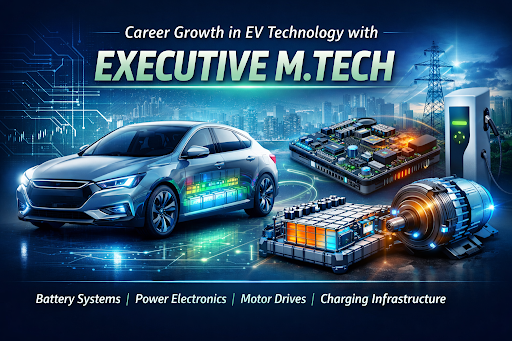
There are defining moments in the history of engineering disciplines, moments when the accumulated
momentum of decades of incremental progress suddenly accelerates into transformation. Electrical engineering is
living through one of those moments right now, and the catalyst is unmistakable: the global transition to
electric vehicles.
This is not a gradual shift. The EV revolution is restructuring the entire automotive value chain from
powertrain design and battery management to charging infrastructure, power electronics, and vehicle software
architecture. Every dimension of this transformation requires electrical engineering expertise at a level of
depth and specialisation that traditional automotive education was not built to produce.
For electrical engineering professionals, this creates a career opportunity that is both urgent and
significant. The organisations leading the EV transition, global OEMs, Tier-1 suppliers, energy infrastructure
companies, and deep-tech EV startups, are competing intensely for professionals who combine foundational
electrical engineering credentials with the specialised systems knowledge that advanced EV engineering demands.
"The engineers who will define the electric vehicle era are not being recruited from the future. They
are being developed right now through programmes that have the foresight to prepare for it."
The Executive
MTech in Advanced Electrical Vehicle Systems is designed for exactly this moment. It is a
postgraduate programme built around the reality that EV engineering is not a single discipline; it is an
integration of power electronics, embedded systems, battery technology, motor drives, thermal management, and
vehicle-level systems architecture. The professionals who can operate across this full stack are the ones the
industry is looking for.
From Power Grids to Powertrains: The Evolution of Electrical Engineering
Electrical engineering has always been a discipline defined by its adaptability. From the electrification of
cities in the early 20th century to the semiconductor revolution that powered the digital age, electrical
engineers have consistently been at the centre of the most consequential technological transitions in modern
history.
The EV revolution is the next chapter in that story, and it is, by almost every measure, the most complex
systems engineering challenge the automotive industry has ever faced. Building an electric vehicle is not
simply a matter of replacing an internal combustion engine with an electric motor. It requires the precise
integration of battery cell chemistry, pack architecture, thermal management systems, power conversion
electronics, regenerative braking logic, onboard charging systems, motor control algorithms, and vehicle
management software, all operating in real time, within tight safety tolerances, and across extreme thermal and
electrical load conditions.
This complexity is precisely what makes the advanced EV
engineering course landscape so strategically
important. The professionals being trained in EV systems engineering today are not learning a narrow
specialisation; they are developing the capacity to architect and lead the full technical scope of electrified
vehicle development.
"EV engineering is not a subspecialty of automotive. It is a convergence of every domain of electrical
engineering, brought to bear on one of the most complex system design challenges in modern technology."
India's role in this transition is growing rapidly. With government mandates accelerating EV adoption, a major
two- and three-wheeler electrification push, and global OEMs establishing engineering centres in the country,
demand for qualified EV systems engineers with formal postgraduate credentials is intensifying across the
Indian market. The EV Systems Engineering Masters Program represents a direct response to that demand, a
programme built to produce the professionals that this industry urgently needs.
What EV Engineering Actually Demands: A Systems-Level View
Battery Systems & Energy Management
The battery pack is the most complex, most expensive, and most safety-critical component of any electric
vehicle. Designing, managing, and optimising battery systems requires deep expertise in electrochemistry,
thermal engineering, pack architecture, and Battery Management System (BMS) design. EV engineers must
understand how cells degrade over charge cycles, how thermal runaway is prevented, how state-of-charge
estimation algorithms are validated, and how pack integration impacts vehicle-level energy efficiency. This is
one of the most specialised domains in the entire EV engineering stack and one of the most in-demand.
Power Electronics & Motor Drive Systems
The conversion of stored battery energy into mechanical motion and back again through regenerative braking is
governed by power electronics and motor drive systems. Inverters, DC-DC converters, onboard chargers, and motor
control units must be designed for efficiency, reliability, and electromagnetic compatibility under extreme
conditions. Professionals who can design and validate these systems are central to every EV development
programme, from two-wheelers to commercial vehicles.
Vehicle Architecture & Systems Integration
An electric vehicle is a system of systems. The integration of powertrain, chassis, thermal management,
software, and safety systems into a coherent, functional vehicle architecture requires a perspective that
transcends individual component expertise. EV systems engineers who can operate at the architecture level,
defining interfaces, managing integration risk, and making design trade-offs across the full vehicle system,
are among the most valuable professionals in the industry.
Charging Infrastructure & Grid Integration
EV adoption at scale is inseparable from charging infrastructure development. AC and DC fast charging system
design, vehicle-to-grid (V2G) integration, smart charging management, and grid stability implications of
large-scale EV deployment are engineering challenges that span automotive, power systems, and
telecommunications domains. Professionals with the systems knowledge to navigate this complexity are critical
to the success of every national EV deployment strategy.
Executive MTech in Advanced Electrical Vehicle System
The Electric Vehicle Technology Programme is an executive-format postgraduate degree designed for practising
engineers who are ready to specialise in one of the most consequential technology transitions of the current
era. The EV MTech course structure integrates the full spectrum of EV systems engineering from fundamental
power electronics and battery management to advanced vehicle architecture and embedded software within a
rigorous academic framework designed to produce professionals who can lead at the systems level.
This is not a certification or a short-form training programme. It is a full Executive MTech, a postgraduate
qualification that carries the academic credibility and professional recognition of a degree from a premier
institution, delivered in a format designed for professionals who cannot step away from their careers to pursue
full-time residential education.
The MTech
EV technology admission process is structured to be rigorous yet accessible, ensuring that
professionals with the right foundation can enter the programme efficiently and without unnecessary friction.
Admission Process
| Step |
Process Description |
| Step 1 |
Fill out an online application form, upload the required documents and submit the application. |
| Step 2 |
Make the application fee payment to confirm your submission. |
| Step 3 |
Shortlisting based on the eligibility criteria fulfilled by the applicant. |
| Step 4 |
If shortlisted, you will receive a formal offer letter from the institution. |
| Step 5 |
Pay the programme fees in full within 7 days of receiving the offer letter to confirm admission. |
Eligibility Criteria
Work Experience: Minimum 2 years of relevant experience within the preceding 3 years.
Educational Qualification (any one of the following):
- B.Tech / B.E. / B.Sc. in a relevant field (minimum 4-year programme)
- M.S. or M.Sc. in a relevant field (minimum 2-year programme)
- M.C.A. (minimum 2-year programme)
Note: Candidates applying on the basis of an M.Sc. / M.S. / M.C.A. degree must hold an undergraduate degree
in a science or engineering field.
The eligibility framework reflects a deliberate design choice: this programme is built for professionals who
bring real-world engineering experience to the classroom. The minimum two-year experience requirement is not a
formality it is a signal that the learning model is built around the integration of academic depth with
professional application.
The Career Architecture of the EV Engineering Leader
What does a career look like for a professional who holds an Executive MTech in Advanced Electrical Vehicle
Systems? The answer depends on where they start, but the direction is consistently upward and significantly
more accelerated than that of their peers without the postgraduate credential.
For engineers currently working in automotive, power electronics, embedded systems, or related domains, the
Executive MTech provides the specialised EV systems knowledge and the formal credential that enables
progression into senior engineering roles that are specifically defined around EV technology. These include
positions such as Battery Systems Engineer, EV Powertrain Architect, Power Electronics Design Lead, BMS
Development Engineer, EV Platform Integration Lead, and Charging Systems Architect.
For professionals with broader electrical engineering backgrounds who are seeking to transition into the EV
sector, the programme provides both the domain knowledge and the credentials that make that transition credible
and competitive. The advanced EV engineering course is specifically structured to equip professionals for this
kind of cross-domain career move.
"In the EV industry, the difference between a capable engineer and a systems leader is the ability to
see the whole vehicle, not just the component. That perspective is what this programme is built to develop."
Beyond specific roles, the Executive MTech carries a credential value that compounds over time. As EV
engineering matures from an emerging specialisation to a standard discipline, postgraduate qualifications in EV
systems will become the baseline expectation for senior roles, much as postgraduate credentials in embedded
systems or power electronics became standard in those fields as they matured. The professionals who hold those
credentials today will be the ones positioned for leadership as the industry scales.
Curriculum Built at the Intersection of Academy and Industry
The credibility of an EV Systems Engineering Masters Program is ultimately measured by the professionals it
produces and the roles those professionals can lead. Achieving that standard requires a curriculum that is
built not just with academic rigour, but with direct input from the engineering leaders who are actively
solving the problems that students will face in their professional careers.
The most effective EV engineering programmes are designed around real vehicle development challenges, not
abstracted problem sets. That means exposure to actual Battery Management System design methodologies,
validated motor control architectures, thermal simulation tools used in production programmes, and the systems
engineering processes that govern how global OEMs manage the integration of complex vehicle subsystems.
Faculty who combine deep academic expertise with active industry engagement bring a perspective that neither
pure academics nor pure practitioners can offer independently. For executive students who already have
professional experience, this combination is what makes the learning genuinely valuable; it extends and deepens
what they already know, rather than simply restating it in an academic register.
Industry collaboration also means access to professional networks, exposure to emerging research from leading
EV technology development organisations, and, in some cases, direct connections to the companies that will be
hiring programme graduates. For working professionals who are investing significant time and resources in a
postgraduate programme, these connections represent a tangible dimension of the return on that investment.
The Electric Decade: Why Now Is the Right Moment to Lead
The global EV market is at an inflection point. Major automotive markets are setting firm timelines for the
transition away from internal combustion vehicles. Battery technology is maturing rapidly, with energy density
improvements and cost reductions continuing to reshape the economics of electrification. Charging
infrastructure is scaling in parallel with vehicle adoption. And governments worldwide, including India, are
backing EV development with policy frameworks, procurement commitments, and industrial subsidies that are
accelerating the transition beyond what pure market dynamics would produce.
For electrical engineering professionals, this translates into a labour market that is increasingly skewed in
their favour. The pipeline of EV-qualified engineers entering the workforce is not growing fast enough to meet
the pace of industry demand. Organisations are competing for a limited pool of professionals with verified EV
systems credentials, and that competition is driving both compensation premiums and accelerated career
progression for those who hold the right qualifications.
India's position in this landscape is particularly compelling. The country is on track to become one of the
world's largest EV markets, with a rapidly developing ecosystem of domestic manufacturers, global OEM
engineering centres, battery gigafactories, and charging infrastructure developers. The demand for EV-qualified
electrical engineers in India will intensify significantly over the next five to ten years, and the
professionals who have invested in postgraduate EV credentials now will be positioned to lead that market, not
simply participate in it.
"The electric vehicle era is not a moment to observe from a distance. It is a platform to build on.
The engineers who prepare for it now will be the ones defining its outcomes a decade from now."
The Executive MTech in Advanced Electrical Vehicle System is the structured pathway through which practising
electrical engineers can make that investment in a format that respects the professional commitments they have
already built, while delivering the academic depth and industry credibility that leadership-level careers in EV
engineering require.
FREQUENTLY ASKED QUESTIONS
Who is the Executive MTech in Advanced Electrical Vehicle System designed for, and
what professional background is most suitable?
The programme is specifically designed for practising electrical engineers, electronics engineers, and
professionals from adjacent disciplines such as mechanical engineering, automotive systems, power
electronics, and embedded systems who are seeking to specialise in EV technology and advance into
senior or leadership-level roles within the industry. The minimum eligibility requires a relevant
bachelor's or postgraduate degree and at least two years of professional experience in a relevant
field within the preceding three years. The executive format means the programme is structured around
professionals who are currently working and cannot pursue full-time residential education, making it
particularly well-suited for mid-career engineers who are ready to make a significant career
transition without pausing their professional momentum.
What does the EV MTech course structure cover, and how does it differ from a
general electrical engineering postgraduate programme?
Unlike a general electrical engineering postgraduate programme, the Executive MTech in Advanced
Electrical Vehicle Systems is purpose-built around the full technical scope of EV systems engineering.
The curriculum is architected around the core disciplines that define EV development: battery systems
and energy management, power electronics and motor drive design, Battery Management System (BMS)
engineering, vehicle architecture and systems integration, onboard and off-board charging system
design, thermal management, embedded software for EV control systems, and vehicle-level validation and
testing. This integrated, EV-specific curriculum produces professionals who can operate at the systems
level, not just within a single component domain, which is precisely the capability that the EV
industry requires from its senior engineering talent.
How does the admission process work, and how long does it typically take from
application to programme commencement?
The admission process is structured across five steps: submitting the online application with required
documents; completing the application fee payment; undergoing shortlisting based on eligibility
criteria; receiving an offer letter if shortlisted; and confirming admission by paying the programme
fees in full within seven days of receiving the offer letter. Candidates are encouraged to prepare
their documentation in advance, including academic transcripts, proof of work experience, and identity
documents, to ensure a smooth application process. The timeline from application submission to offer
letter varies depending on the application cycle, and prospective applicants are encouraged to contact
the admissions office directly for current cycle timelines and intake dates.
What career outcomes and roles do graduates of this Electric vehicle technology
programme typically move into?
Graduates of the Executive MTech in Advanced Electrical Vehicle Systems enter a labour market that is
experiencing significant demand for EV-qualified electrical engineers. Common post-programme roles
include Battery Systems Engineer, EV Powertrain Architect, Power Electronics Design Lead, BMS
Development Engineer, EV Platform Integration Lead, and Charging Systems Architect. These roles exist
across a broad range of organisations, including global automotive OEMs, Tier-1 automotive suppliers,
domestic EV manufacturers, charging infrastructure developers, battery technology companies, and
EV-focused engineering consultancies. In India specifically, the growth of domestic EV manufacturers
and the expansion of global OEM engineering centres is creating a particularly strong demand
environment for professionals with verified postgraduate EV credentials.
Does the programme require full-time attendance, and how is it structured for
working professionals?
The Executive MTech in Advanced Electrical Vehicle Systems is specifically designed to accommodate the
schedules and commitments of working professionals. The programme is delivered in an executive format
that does not require candidates to step away from their professional roles. Instruction is structured
to be compatible with full-time employment, typically through a combination of online sessions,
weekend modules, and structured self-study components. This delivery model means that professionals
can continue to develop their careers and directly apply programme learnings in their existing work
environments while simultaneously earning a postgraduate qualification. For engineers who are already
working in or adjacent to the EV sector, this creates an immediate return on investment that purely
residential programmes cannot offer.