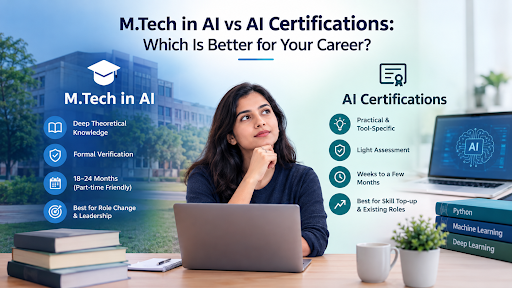
A four-week certificate and a two-year postgraduate credential are now routinely compared as if
they were competing purchases in the same aisle, largely because online learning platforms have priced and
marketed them that way. They are not substitutes for each other, and the professionals who discover this only
after choosing one over the other tend to discover it at the worst possible moment — during a promotion review
or a lateral move into a more technical role.
Why the Comparison Got So Confusing
Search volume around this question has climbed sharply as the number of available credentials has multiplied —
vendor badges, cohort-based bootcamps, university-branded short courses and formal postgraduate degrees are all
now marketed under the umbrella term "AI credential." That crowding has made it genuinely harder for a working
professional to tell signal from noise, particularly because the cheapest and fastest options are also the most
heavily advertised.
The confusion is compounded by the fact that both paths can legitimately claim to teach "AI." What differs is
depth, verification and how much an employer is willing to infer from the credential alone about a candidate's
ability to handle ambiguity, not just execute a known technique.
The Three-Gate Decision Sequence
Rather than weighing pros and cons in the abstract, the choice becomes clearer when run through three
sequential questions. Each gate narrows the decision, and by the third gate, most candidates already know which
path fits.
Gate 1 — How much time is genuinely available?
If the honest answer is a few months at most, a structured degree is unlikely to be completed regardless of its
merits, and the decision defaults toward a certification simply on feasibility grounds.
Gate 2 — Is this a skill top-up or a role change?
Adding one specific capability to an existing role favours a certification. Moving into a fundamentally more
technical or architecture-facing role favours the broader, verified depth a degree provides.
Gate 3 — What does the target employer actually screen for?
Individual-contributor technical roles often accept strong certifications alongside a portfolio. Leadership,
architecture and research-adjacent roles increasingly filter on formal postgraduate credentials before a resume
is even read closely.
Candidates who reach the third gate still undecided usually have a role-change ambition that their current
credential mix does not yet support — which is itself a useful signal.
Same Question, Different Angles
The debate over AI Certification vs Degree is easier to resolve once it is broken into the specific dimensions
that actually predict career outcomes, rather than compared as a single undifferentiated choice.
| Dimension |
AI Certification |
Postgraduate Degree |
| Depth of theory |
Applied, tool-specific |
Foundational and applied combined |
| Verification strength |
Self-paced, lightly assessed |
Formally examined, cohort-verified |
| Typical time investment |
Weeks to a few months |
18–24 months, part-time compatible |
| Best suited to |
Skill top-up within an existing role |
Role change into architecture or leadership |
| Employer screening weight |
Moderate, role-dependent |
High, especially at senior technical levels |
What Employers Actually Reward
Hiring managers rarely say this out loud in job descriptions, but internal screening practice tells a
consistent story: certifications are treated as evidence of initiative and current tool fluency, while a
postgraduate credential is treated as evidence that a candidate can reason through an unfamiliar, ambiguous
problem without a tutorial to follow. Both matter, but they are not interchangeable evidence, and conflating
them in a resume rarely helps a candidate's case.
Where This Actually Leads
The practical shape of an AI career varies considerably depending on which credential mix a professional
builds, but certain roles consistently sit at the intersection of both technical depth and business trust — and
those tend to be the roles that compound fastest in both scope and compensation.
- AI/ML Engineer
- MLOps Engineer
- Applied AI Researcher
- AI Solutions Architect
- AI Product Manager
- Head of AI / Applied AI Lead
Built Around a Working Week
For professionals unwilling to pause an active career, this is usually the deciding practical factor rather
than curriculum content. An AI M.Tech for
working professionals track is structured deliberately around that constraint — weekend and evening
contact hours, project work that can draw on a candidate's existing job context rather than requiring a
hypothetical case study — which is precisely what makes the degree route feasible for someone already several
years into a career.
How Admission Actually Works
The process itself is more procedural than the eligibility debate around it suggests, and most delays
candidates experience come from missing the payment window rather than failing to qualify.
Admission Process
| Step |
Process Description |
| Step 1 |
Complete the online application form, upload the required supporting documents, and submit it for
review. |
| Step 2 |
Pay the application fee to finalise the submission — this step confirms the application has entered
the review queue. |
| Step 3 |
Applications are shortlisted against the published eligibility criteria; there is typically no
separate interview round beyond this screening. |
| Step 4 |
Shortlisted candidates receive a formal offer letter confirming their seat in the cohort. |
| Step 5 |
Admission is confirmed only once the full programme fee is paid — and this must happen within seven
days of receiving the offer letter, a window candidates should plan for financially well in advance.
|
Applying With Intent
Candidates who treat the application as a formality tend to move slower through the process than those who
prepare documentation ahead of time. An Executive M.Tech AI admission cycle typically runs across a limited
number of rounds per year, and the seven-day payment window described above is unforgiving for candidates who
have not already arranged financing before receiving an offer.
Studying Without Relocating
Format flexibility is what ultimately makes the degree route competitive against a certification's convenience.
An Online
M.Tech Artificial Intelligence format delivers the same faculty access and cohort structure as an
on-campus programme without requiring a professional to relocate or resign, closing the single biggest
practical objection working professionals raise before applying.
Final Checklist
- Run the decision through all three gates before comparing programmes — the right gate answer often
eliminates half the options immediately.
- Treat a certification and a degree as complementary, not competing, if time and budget allow for both.
- Confirm the target role's actual screening pattern with someone currently in it, rather than assuming from
the job description alone.
- Arrange financing before applying, given the tight payment window once an offer is issued.
- Revisit the decision if the target role shifts from individual-contributor to leadership — the credential
that made sense at gate three can change.
FREQUENTLY ASKED QUESTIONS
Can a certification and a degree be pursued together?
Yes, and many professionals use a short certification to validate interest or build an immediate skill
before committing to the longer postgraduate route.
Does a certification lose value once a degree is completed?
No — certifications remain useful as evidence of current tool fluency even after a degree is
completed, since tools evolve faster than degree curricula are revised.
Is the postgraduate route only useful for a full career pivot?
No — it is also common among professionals staying in their current domain who want the theoretical
depth to defend technical decisions at a senior level.
What happens if the fee payment window after an offer letter is missed?
Policies vary by cycle, but missing the payment window typically forfeits the offered seat, so
candidates should confirm financing before applying rather than after receiving an offer.
Is prior coding experience required before applying?
Some technical familiarity is expected given the applied nature of the coursework, but candidates are
not expected to arrive with production-level engineering experience.